
California Wanted Notices
No single California list shows every person with an active warrant. Tips routed through the California Department of Justice go to its Bureau of Investigation and Intelligence. Its Wanted Persons System, called WPS, is a law-enforcement file closed to the public. CDCR handles selected parole-related tips. The U.S. Marshals Service posts fugitive profiles by federal district. Each layer serves a different purpose.
Start with the agency that issued the notice. Read its own instructions. A notice may ask for information, yet it never authorizes a reader to investigate, identify, follow, or confront anyone. If a link has gone dead or a notice looks changed, call the listed agency and ask whether it still stands.
A removal means little on its own. Court records, where public, carry the case history and the outcome.
Safety first. Never approach, follow, or try to detain anyone named in a notice. Call 911 if danger is immediate. Send anything else through the official tip route on the agency's page.
Selected California Lists
The official pages below cover selected groups and purposes. They help as starting points. Still, none replaces a local court clerk or an all-county warrant database.
| Official source | What it covers | Photo and search limits | Safe route |
|---|---|---|---|
| California DOJ wanted contact | Tips to the Bureau of Investigation and Intelligence. | A tip route and selected-list infrastructure, not a complete public fugitive search. | Use the contact details on the current DOJ page. |
| DOJ Wanted Persons System information | Explains the statewide computerized fugitive file used by law enforcement. | The system is not a public lookup tool. | For public questions, contact the relevant issuing agency. |
| CDCR parole tip line | Information about people shown on a wanted-sex-offender list or parole matters. | It is not a complete public roster of parole absconders. | Use the published email for non-emergency information. |
| CDCR Office of Correctional Safety | Describes Fugitive Apprehension Teams and public-safety work. | It does not give the public a complete internal parole or warrant file. | Follow CDCR’s official tip instructions. |
| U.S. Marshals profiled fugitives | Selected federal fugitive profiles. | Profiles are not a complete public fugitive database. | Use the listed district’s official contact route. |
The U.S. Marshals Service splits California across four districts. The district directory shows which federal office serves a given county. Treat it as a jurisdiction map, not a search for every federal warrant. A sheriff's notice may still cover a separate county matter even when a federal profile exists.
The map helps when a federal notice names only a city or county. The Central District takes Los Angeles, Orange, Riverside, San Bernardino, San Luis Obispo, Santa Barbara, and Ventura. Imperial and San Diego belong to the Southern District. The Northern and Eastern districts each span many counties, so confirm the assigned office through the current directory instead of guessing.
Profiles are chosen cases, not a census. Someone can hold a local court warrant yet appear nowhere on a DOJ tip page or a Marshals profile. A profile may also move or vanish. The issuing agency alone knows the current status.
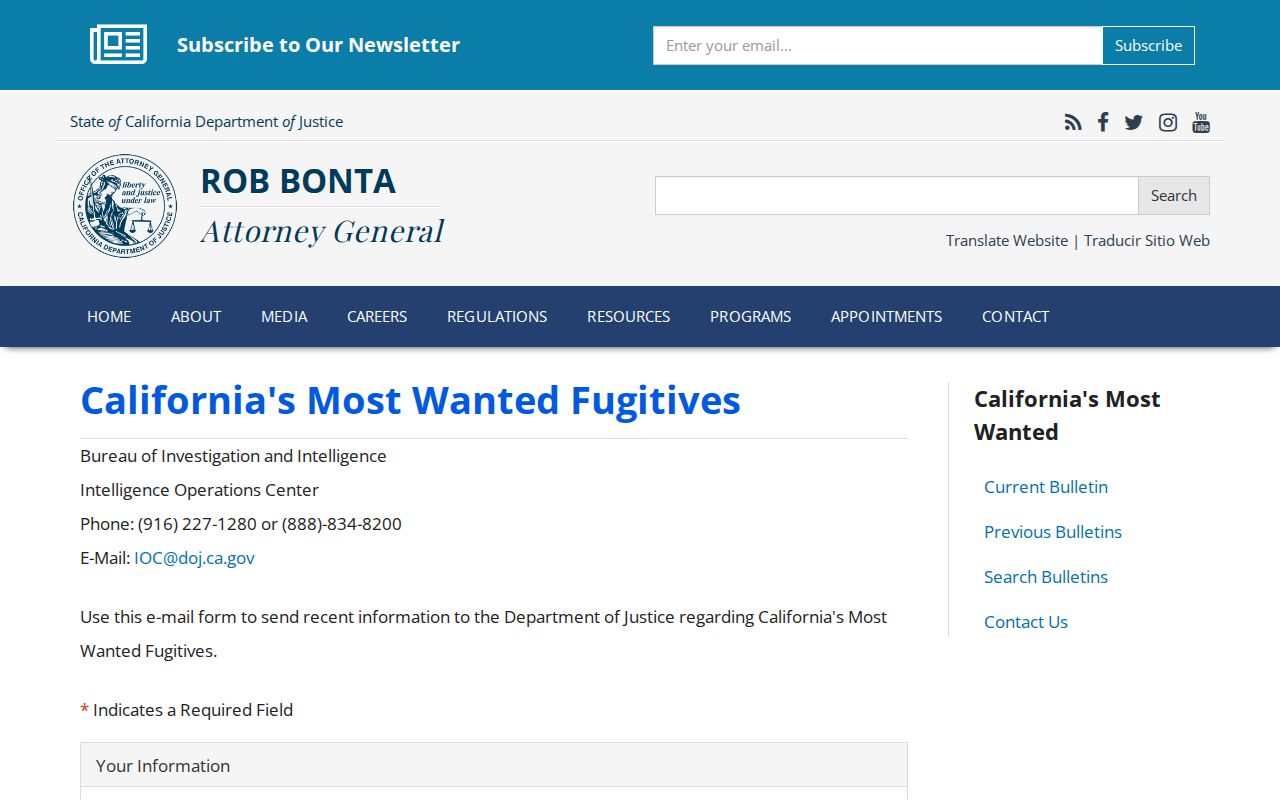
The California DOJ wanted contact page posts the state tip route and shows no portraits of individuals.
Reading California Wanted Notices
A notice is only as good as its source and date. The posting agency can confirm whether the request still stands. Names repeat. A shared name, age, or town is not a match. Fields vary by list. A current notice may carry a photo, identifiers, an agency contact, or a tip request.
Each source has its own route. The DOJ contact page lists phone and email tips. CDCR gives its own parole tip instructions. Marshals profiles point you to a district. None of it belongs in a new image gallery or a crowd-sourced identification effort. Keep the agency, date, and scope attached to any report.
When a notice disappears, do not assume a warrant was dismissed. It may have been withdrawn, replaced, or relocated. Ask the issuing agency. Turn to the court record for the outcome where one is public.
California Warrant Checks
A wanted list and a warrant check answer different questions. The WPS stays restricted to law enforcement. The DOJ public page works as a tip route only. California has no single statewide public docket confirming every county warrant. A possible local warrant must go through the court or agency tied to the case. The right route depends on where the matter was filed.
California Courts sends case-related searches to the Superior Court in the filing county. Not every record is online. Remote access rules limit what can be viewed. A local agency may route warrant questions to a clerk or records unit. Follow the office's own instructions. Do not lean on a third-party directory or a stale search result.
| Record or notice type | Public route | What the route cannot establish |
|---|---|---|
| Local case or court warrant | Ask the Superior Court or issuing county agency tied to the case. | A failed online search does not prove that no warrant exists. |
| DOJ Wanted Persons System entry | Public page gives tip contacts; the internal system is for law enforcement. | The public cannot search the complete WPS file. |
| CDCR parole-related notice | Use CDCR’s posted tip page for the listed categories. | It is not a complete list of parole absconders or county warrants. |
| Federal fugitive profile | Use the U.S. Marshals profile and district directory. | Selected profiles do not cover every federal warrant. |
Start with one jurisdiction and one case number. California's court lookup guidance makes no promise that every order shows up online. Remote access rules can shield criminal and juvenile files. A sheriff may also push warrant questions to a separate records or warrants unit. So when a search comes back empty, ask the court clerk which public record request fits before assuming anything.
"Wanted," "absconded," and "warranted" are not the same thing. The DOJ's WPS is a law-enforcement fugitive file. CDCR's public tip page handles selected parole matters. A U.S. Marshals profile is a chosen federal notice. A county court record belongs to a local case, and every one of these sources carries its own scope and update schedule.
Checking California Warrant Status
Tie any person-specific search to an official case source. The path below shows how to ask the right office. No public search promises a view of every active record.
- Identify the county or court connected to the known arrest, charge, or case. If that is unclear, use the official county directory to find the local agency sites and ask which office holds the inquiry.
- Use the Superior Court case lookup guidance to reach the court where the case was filed. Search by the information the court accepts, then call the clerk if the online record is limited or absent.
- Ask the issuing agency how it confirms warrant status and what records are public. A general tip page or wanted profile is not a substitute for direct confirmation.
- If the possible warrant concerns you, contact a lawyer or the court for instructions on resolving it safely. Do not try to evade service or use another person to make contact.
California Courts says local records may stay offline. The Judicial Council does not hold each county's criminal case file. Sealed, confidential, or restricted information can slip past a search. A clerk's answer may point to the next lawful step. Still, only the responsible office can confirm its own current record.
For a local inquiry, the county site may lay out the sheriff's records route. It may also list useful city police sources. The California County Directory links readers to those county and city pages. Wondering about a recent arrest instead? The statewide California records page maps the official booking paths. It covers current custody, short arrest feeds, and released records.
Sending a California Tip
Send any tip to the agency named on the active notice. The California DOJ page lists 916-227-1280 and 888-834-8200, with `IOC@doj.ca.gov` for information. CDCR's Division of Adult Parole Operations handles parole matters and the wanted-sex-offender list. It posts `CDCRDAPOTIPLINE@CDCR.CA.GOV`. These are contact routes, not a reward program. Neither office promises a statewide reward, nor does either one guarantee anonymity.
For a federal profile, follow the district-specific instructions. Call 911 for an immediate threat or a crime in progress. With a non-urgent tip, share only what you know first-hand. Name the notice you are answering. The agency decides whether follow-up is needed.
- Open the agency’s current notice and make sure it is the official page.
- Use the phone or email shown there. Do not post a tip publicly or send private details to an unrelated account.
- Describe the time and place of what you observed, and avoid guessing about identity or guilt.
- Leave any contact details only as the agency’s instructions require; do not assume a page promises anonymity unless it says so.
Note: A tip page may remain online after its list changes, so ask the named agency whether a specific notice is still active.
California's DOJ tip page lists 916-227-1280 and 888-834-8200, with `IOC@doj.ca.gov` for information. CDCR posts `CDCRDAPOTIPLINE@CDCR.CA.GOV` for parole information and its wanted-sex-offender list. Neither route mentions a reward or anonymity. Follow the current official notice for instructions. Never speak for the agency.
California Wanted Record Limits
A wanted notice is not a court judgment. It can refer to an allegation, an outstanding order, or a parole matter, each with its own process. The notice does not tell a reader whether a later court hearing changed the status. A person shown in an official photo remains presumed innocent unless a court establishes guilt on a filed charge.
Keep the source, date, and later court outcome together. If the matter has ended, check the court or issuing agency instead of relying on a cached portrait. The site does not host wanted photos or invite readers to identify a person; the correct action is to send a relevant tip to the agency and leave enforcement to trained officers.