
CDCR Mugshots and CIRIS
The California Department of Corrections and Rehabilitation runs the state prison system and its parole functions. CIRIS is its public locator. The name stands for California Incarcerated Records and Information Search. It is not a statewide sheriff roster. County jail bookings stay out of it entirely. The public display shows text fields only. No offender photograph appears. Still, a search can surface a CDCR number, a location, an admission date, or parole detail. CDCR calls this selected information, not the official file. Entries can contain errors or omissions, lag an admission by days, or disappear for safety and security reasons. The distinction matters after a new arrest. That booking photo belongs to the local arresting agency or jail, since a prison profile covers a separate custody event. A photo-free result proves little. CDCR may still hold an identification image, and a county booking record can exist even when the locator shows nothing.
Search the CDCR Offender Locator
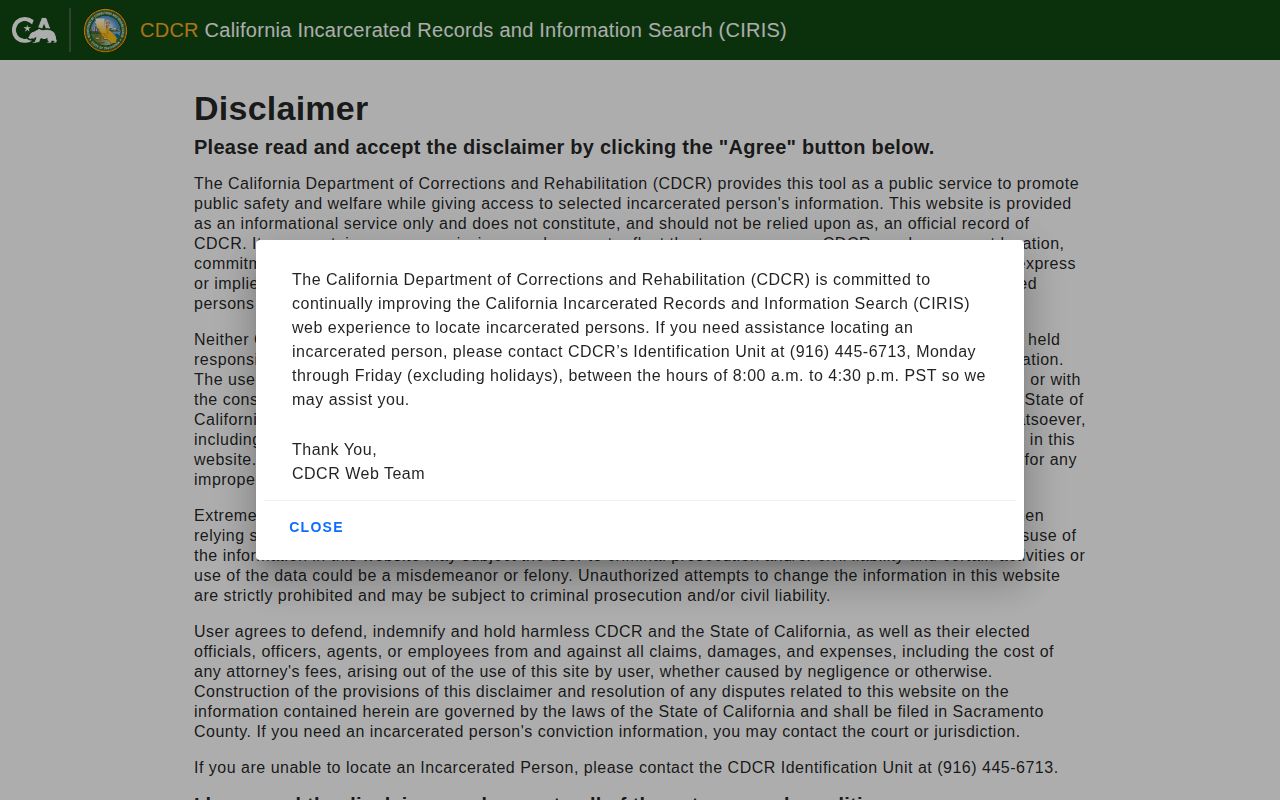
Begin at the official CIRIS search page. The public form takes either a name or a CDCR number. Accept the on-screen disclaimer first. Type the exact spelling or department number you have, since a common name can return several people and the profile fields are what separate them.
| Search field | Required? | How it is used |
|---|---|---|
| Last name | Required for a name search | Begins the search by the name held in the CDCR record. |
| First name | Optional | Narrows a name search when the first name is known. |
| Middle name | Optional | May help separate people with similar names. |
| Age range | Optional | Can narrow the name results using the range shown on the form. |
| Commitment county | Optional | Filters by the county connected to the commitment record. |
| CDCR number | Use the number-search option | Searches by the department identifier rather than a name. |
Enter the exact last name first. Add a first name or age range only if the results are too broad. A known CDCR number is the cleaner route. Open the profile and jot down your search date, because transfers and new admissions may not post right away.
- Open CIRIS and accept its disclaimer.
- Choose a name search or CDCR-number search, then enter the fields the form allows.
- Compare name, age, number, commitment county, and current location on the profile.
- For a photo or a record not displayed online, use the appropriate CDCR request route below.
The official CIRIS landing page provides the current state-custody locator and search fields.
California CDCR Profile Fields
A CIRIS profile can show the fields listed when CDCR makes them public. Parole or hearing details may be missing. Not every person has every field. Treat the profile as a pointer toward the state custody record rather than a certified copy or full case history.
| Profile field | What it indicates |
|---|---|
| Name and CDCR number | The person’s name as listed and the department identifier. |
| Age | Age shown in the selected public profile. |
| Admission date | The state-prison admission date recorded by CDCR. |
| Current location | The institution or custody location shown in the locator. |
| Commitment county | The county connected to the commitment record. |
| Parole eligibility | Eligibility information where the profile provides it. |
| Board of Parole Hearings | Dates or outcomes where available in the selected profile. |
| Photo | No public photo field is shown in the current CIRIS interface. |
For locator questions, the CIRIS identification unit answers at 916-445-6713. Hours run Monday through Friday, 8:00 a.m. to 4:30 p.m. Pacific. That line covers the locator itself. Photo requests go elsewhere. Read a blank result narrowly, because delays after admission, safety omissions, and the locator's public limits can all hide a record. It does not erase a prison history. Another agency may hold the photo.
California CDCR Photo Policy
CDCR's Media Policies page handles offender identification photos. The policy labels these images public documents. Both media and non-media requesters can ask directly, with no CPRA filing required. Denial is still possible. A photo can be withheld when release might endanger an incarcerated person or parolee, or damage an ongoing investigation. Serving or former state prisoners route photo questions to `opec@cdcr.ca.gov` or 916-445-4950. Include the full name plus a date of birth or CDCR number. Two business days is the stated reply window. That is a response expectation only. The image itself may still be denied. A former parolee changes the picture. When one is newly arrested, CDCR says it will contact the arresting or investigating agency. The new booking photo sits with city police or a county sheriff. Ask that local custodian. Keep the two CDCR routes separate. The media policy fits the identification-photo inquiry, while the CDCR public-records portal serves other records. A careful request names the image apart from custody history and asks which system holds each record.
California's Attorney General lays out the disclosure process for formal record requests in a public-records guide.
Former California Offender Records
California's CDCR makes no public promise that every former offender stays searchable in CIRIS. It also publishes no schedule for updating photos in public results. Internal operational documents do describe how images are captured and stored. Those internal practices, though, say nothing about what a public search returns. A discharged person can drop out of the current custody locator. CDCR may still hold the underlying records.
A missing result is not the end of the road. Check the spelling and the number first. Then try CDCR's media route or its request portal for the record type you need. For a brand-new arrest, the arresting agency is the right contact instead. Keep in mind that a CDCR result is not a county booking record. A missing CDCR profile proves only one thing. There is no state profile. Other records may still exist elsewhere.
California's record-relief statutes can change how qualifying arrest and conviction records get disclosed. They do not, however, promise that every identification image disappears. If you hold a signed court order or a disposition, send it to the record holder. Ask what the department can update. The County Directory links out to the relevant county and court paths across the state.
CDCR Photo Requests in California
Start a photo inquiry through the published media route. Other CDCR documents go through the department's request portal. The California Public Records Act gives the agency ten days for an initial determination, and unusual circumstances allow a written extension of up to fourteen more. None of that guarantees a delivery date, so plan for flexibility.
- Decide whether the request is for an identification photo, custody history, or another CDCR record.
- For the photo policy route, email the Office of Public and Employee Communications with a full name and date of birth or CDCR number.
- For other records, use the CDCR public-records portal and describe the record, date range, and relevant identifier.
- Ask the department to identify any safety or investigation limit and to release nonexempt portions where possible.
Research data requests go to a separate mailbox, `data.requests@cdcr.ca.gov`. That address is for statistics only. Photos and custody questions do not belong there, and juvenile records stay off limits without special authorization.
Note: A two-business-day response expectation for a media inquiry is not a decision that a photo will be released.
CDCR and County Booking Photos
These two systems capture different moments in a person's record. A local booking record begins when someone is arrested. A CDCR profile, by contrast, concerns state-prison custody. The custodians and the photo rules differ too.
| Record | Who holds it | Public route | Photo status |
|---|---|---|---|
| Recent county booking | Arresting police agency or county sheriff. | Local roster, booking log, or records request. | Depends on county policy, custody status, and release exceptions. |
| State-prison custody | California Department of Corrections and Rehabilitation. | CIRIS locator for text profile fields. | No public photo field in the current CIRIS interface. |
| CDCR identification image | CDCR records and media office. | Media inquiry or public-records portal, depending on record type. | May be withheld for safety or an ongoing investigation. |
A county booking photo can sit in a sheriff's file long after the person walks out of custody. Retention and disclosure rules govern how long. A sentenced person may later show up in CIRIS. Yet that state profile never replaces the county booking record. It shows no public image either. Start with the record type you actually need, not just the person's current location.
California CDCR Record Limits
CIRIS is a locator, not the official record. It can run incomplete or lag behind events. The public view may omit someone for safety or security reasons. The media policy also allows withholding when release could endanger a person or interfere with an investigation. So ask CDCR which route applies. Ask whether a record is held. Do this before reading anything into a missing search result. State custody, county booking, parole, and court outcomes remain distinct tracks. Turn to court records for a disposition. Go to the arresting agency for a new booking. Whenever you cite a public profile, keep the source and its date with it.