
California Busted Mugshots
A mugshot is an identification photo taken at booking. People hunting for California busted mugshots usually start with a local roster. The picture is bigger than that. The arresting agency and the jail document the event itself, while the court builds a separate case file. Each answers a different question. A jail roster shows who is locked up right now, while an arrest log may cover only the past few days. A booking record can linger long after release. A court docket, by contrast, tracks whether a charge was filed and how the case ended. State-prison profiles belong to CDCR, not the county jail.
No single California mugshot database ties every sheriff, police department, court, and corrections office together. That gap is practical, not proof a record is missing. A name can come up empty for several reasons. A county portal may list current custody only. A short log can age out, a photo may never have been released, or the case file may be sealed. A result describes one search of one source, nothing more. It cannot tell you a person was never arrested.
Go to the office that created the record. Keep the date and custody status attached to whatever you find. Aggregator screenshots go stale fast, and copies often lack the later court outcome.
Read the status with the record. A booking photo proves an arrest happened, nothing more. Check the court disposition before calling a case a conviction, an acquittal, or a dismissal.
California Booking Record Fields
California Government Code §7923.610 lists the arrest information agencies generally must disclose. Statutory exceptions still apply. The statute covers key facts about an arrest. It does not promise every portal shows each field the same way. Booking photographs are not on the mandatory list at all. The California Attorney General has stated that a sheriff may decide whether to release a booking image. That call comes after weighing the public-records law and its exemptions.
The table describes the statewide arrest-information categories the statute sets out. A booking agency may use different labels. It may drop a field when an exception applies, or post only part of the data online. When labels conflict, the statutory text controls over whatever a vendor's screen says.
| Record field | What it can show |
|---|---|
| Identity and description | Name and occupation, plus a physical description such as age, sex, and identifying features as held by the agency. |
| Arrest event | Date, time, location, and circumstances of the arrest, subject to limits on protected details. |
| Booking event | The booking date and time recorded by the responsible agency. |
| Custody or release | Bail amount, release information, or the place where the person is being held when that information is public. |
| Accusation and holds | Charges as recorded at arrest and outstanding warrants or holds. These entries can change and do not establish guilt. |
| Booking photo | A separate image request. California law does not make the photo part of the mandatory §7923.610 list. |
For the photo itself, ask the arresting agency or the jail that holds it. A sheriff can release the arrest details and still withhold the image. Request the nonexempt portions and the legal basis for any denial rather than assuming a public booking record comes with a public picture.
Requesting California Booking Records
The California Public Records Act is the route. It reaches any county or city record that is not online. Send the request to the agency that made or keeps it. Did the booking happen in a different county from the arrest? Then contact the booking custodian and the arresting department both. The County Directory routes to each county's local source page. It helps you find the right office.
A clear, narrow request beats a broad demand the agency may not fulfill. The Attorney General's public-records guide walks through the request process. Government Code §7922.535 sets the initial determination window. An agency gets ten days to decide whether records are disclosable. Unusual circumstances can bring a written extension of up to fourteen more days. That deadline covers the response only. Copies may take longer.
- Identify the person and, if known, the arrest date, booking number, arresting agency, and county. Ask for the booking record and any releasable photo as distinct records.
- Request segregable nonexempt material. Ask the agency to cite the basis for a withheld record or redaction, such as a safety, privacy, juvenile, or active-investigation limit.
- Send the request through the custodian’s public-records route. Keep the submission date and the agency’s response; follow up with the arresting department if it says another office owns the image.
Under the CPRA, agencies may generally charge fees. Those fees are tied to direct duplication costs. The Attorney General cites ten cents per page for its own paper copies. That example is not a statewide flat fee. Not every sheriff or police department follows it. Check the receiving agency's current fee schedule before ordering extensive copies.
State-prison images run through a different door. CDCR maintains a separate media inquiry route and its own records portal. The posted policy sets a two-business-day expectation for replies to media-photo inquiries. A reply never guarantees the image will be released. The CDCR section below covers that state-prison path in more detail.
Note: A request deadline covers the agency’s initial decision, while search, review, redaction, and copy work may take longer.
California puts one firm rule on booking photos. Under the California booking-photo statute, a publisher cannot demand money from the person pictured just to take a photo down, fix it, or hold it back. That is the limit of the law, though. It grants no universal erase button. Publishing a truthful photo stays lawful, and no right of deletion spans every copy online.
Older images take more digging. A county's normal CPRA request may come up empty because the record aged out or moved to an archive. Ask the original sheriff or police department what its retention schedule did with the file. The State Archives keeps some historic prison collections. It does not hold a full statewide set of modern county bookings.
Need to file a records request? The California Attorney General's public-records guide explains where to send it and how agencies decide access questions.
California Busted Mugshot Law
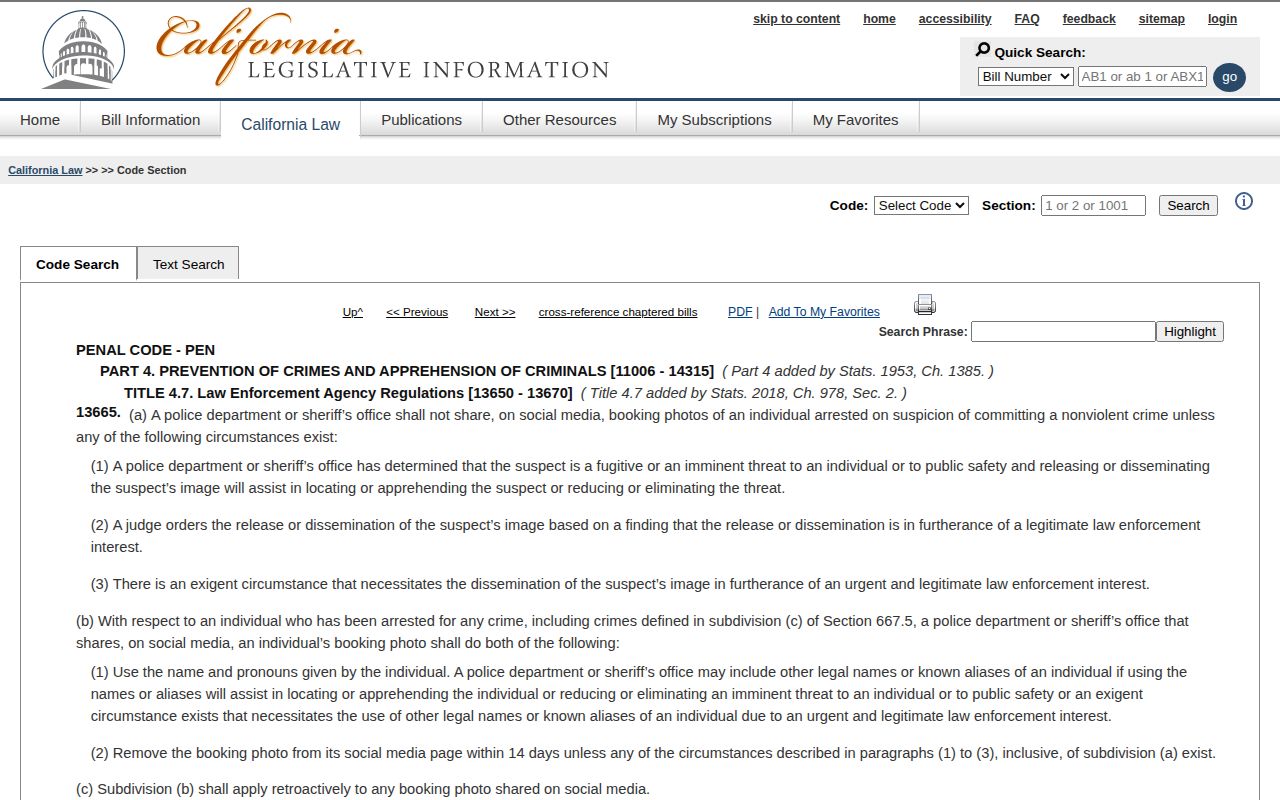
Two different California laws get tangled together, so untangle them. Civil Code §1798.91.1 targets publishers. It forbids soliciting, requiring, or accepting anything of value from the person in a booking photo. The exchange must be for removing or altering the image. Publishing a truthful image, by itself, is not what the law bans. Penal Code §13665 works the other angle. That one restricts when law-enforcement agencies may post booking photos on social media. Exceptions exist. A fugitive qualifies. A pressing public-safety threat, a judge's order, or an urgent law-enforcement need also qualify. The statute leaves agency websites, public-record requests, court exhibits, and news coverage alone.
The pay-to-remove ban dates to 2014 and took effect January 1, 2015. A violator can owe at least $1,000 per violation. Actual damages are possible too, plus costs and attorney fees. Agencies may still charge a reasonable administrative fee to correct their own records. That is not the same as a private publisher shaking down the person depicted. Check the statute's scope before assuming a removal request guarantees deletion.
The California Legislature's text of Penal Code §13665 spells out the narrower social-media rule for agencies.
Court relief changes what officials disclose. It rarely reaches every private copy. Penal Code §851.91 lets a person ask to seal an arrest that never led to a conviction, and §851.93 offers automatic arrest relief in some cases. Conviction relief under §§1203.4 and 1203.425 carries its own limits and exclusions. A court order binds official records. It cannot force a newsroom or archive to scrub a historical story or photo.
For third-party sites, start with a free route if one is posted. Send only the documents the policy requires. Busted Newspaper, RecentlyBooked, Mugshots.com, Arrests.org, and Mugshots.zone are private publishers, not California agencies. Their policies vary. Some allow free requests for certain court outcomes or mistaken identity; others post no clear California-wide process. A free request is never a promise. And never pay a site that demands money from the person shown in exchange for removing or changing a booking image.
Note: Sealing or automatic relief changes access to official records, but a separate request may still be needed for a privately held copy.
Find California Busted Mugshots
Start any search by picking the right layer. County systems track recent arrests and local jail custody. CDCR covers state prison. Superior Court records show case events and outcomes, while federal and immigration systems handle narrower custody groups. No single lookup does it all.
- Find the county or city agency that made the arrest, then open that county’s official roster, booking log, or records-request page.
- Check the posted custody and photo rules. A current roster may only show people still held, and a photo may require a detail click or may not be public at all.
- If the person is not in local custody, use the state, court, federal, or immigration source that matches the question. Keep the result date and verify the case outcome separately.
- If the online view is missing or has aged off, ask the responsible agency for the booking record and any releasable image.
A roster proves current local custody. That holds only as far as the agency vouches for its data. Release someone and they drop off. The booking record itself stays with the sheriff. A prison sentence moves the person to the CDCR locator. So a failed roster search proves nothing about whether a booking happened.
California Busted Mugshot Sources
Go to official sources first. Reach for a second source only when it adds a real lead. The County Directory connects to local pages. Those pages cover county rosters, city police records, and request paths. The table flags what each source answers and where a photo may be missing.
| Source | Record layer | Photo or status limit | Where to start |
|---|---|---|---|
| County sheriff or arresting police | Recent booking, local custody, arrest record, or press release. | Photo release varies by agency; a public arrest record does not guarantee a public photo. | County roster or the agency’s records office. |
| County booking log | Recent bookings or releases within the local feed window. | Some logs are photo-free or only retain a short date range. | The county’s own site or public-records request. |
| CDCR CIRIS | State-prison custody, commitment county, and parole-related profile fields. | The current public locator has no public photo field. | CDCR’s official search. |
| Superior Court | Filed criminal case events and disposition where public and online. | There is no single statewide criminal docket; remote access is limited. | California Courts case lookup guidance. |
| Federal Bureau of Prisons | Federal custody and release-related information. | The public locator has no booking-photo gallery. | BOP inmate locator. |
| ICE Online Detainee Locator | People currently held or recently transferred into ICE custody. | It is not a photo source and does not cover every person with immigration contact. | ICE locator. |
| Secondary arrest sites | Copied or republished entries from local sources. | Unofficial, possibly stale, and not a substitute for a court disposition. | Use only as a lead, then verify at the agency or court. |
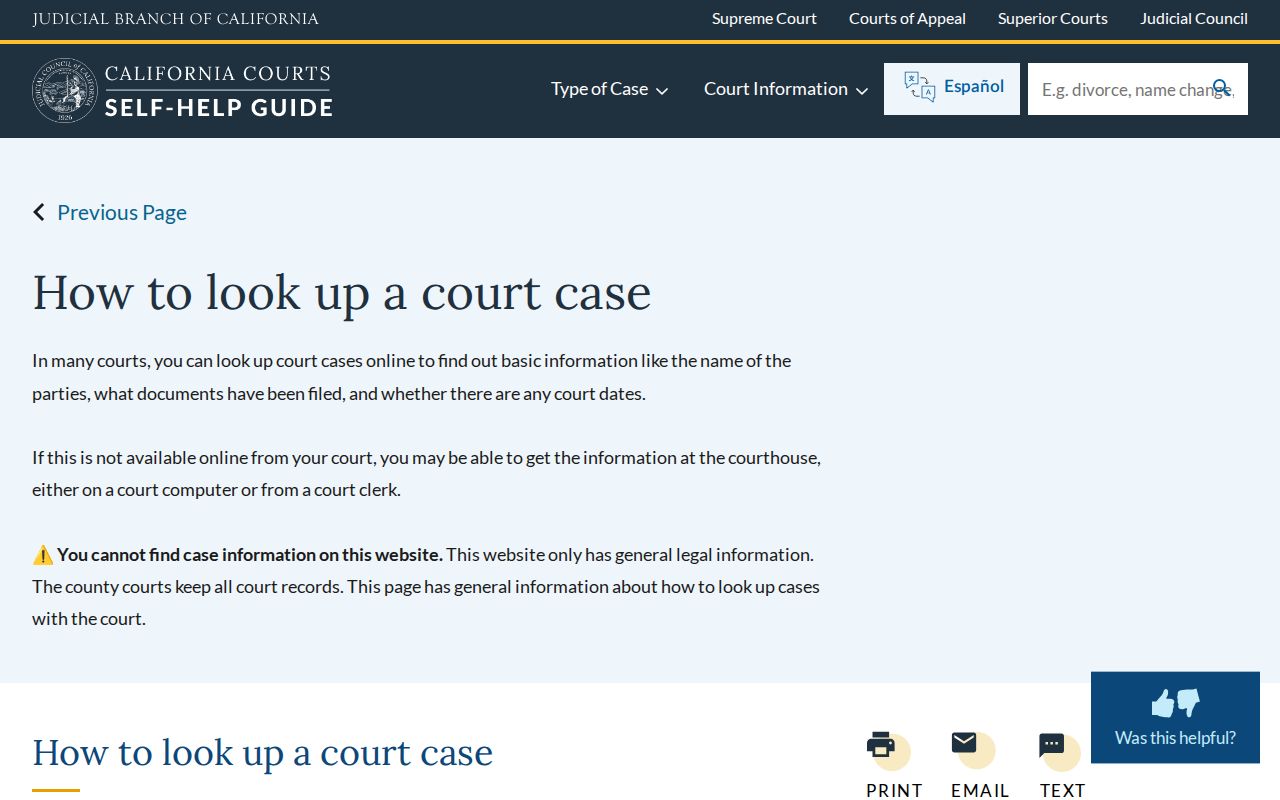
California Courts says plainly that not everything is online. The Judicial Council does not store local criminal records. Ask the court where the case was filed. A docket can name a charge or a result, but it will not supply a mugshot. Access rules also shield some criminal and juvenile files from remote view.
California Courts' lookup page points to each county Superior Court. It also notes that online coverage falls short of complete.
California County Roster Patterns
County practice is a patchwork, not one statewide feed. One office runs a live inmate search. Another posts a brief arrest log or a date-filtered portal. Some publish a daily PDF. Some post no web roster at all. Counties on the same vendor can even differ on photos. A missing face might mean release, a switched-off photo feature, agency approval rules, or a protected record. It does not mean no image exists.
| Local system | Typical view | How to continue |
|---|---|---|
| Live current-inmate search | Name and custody details, sometimes behind a separate result page. | Search the county’s official roster and read its photo policy. |
| Static HTML roster | A list in name or date order, with detail links in some counties. | Open the agency’s posted record; ask the custodian if a field is absent. |
| Short arrest log | A local time window, sometimes about one to three days. | Move to a booking-record request once the feed ages out. |
| Date-filtered portal | Search by name or booking date in a county system. | Use the portal’s exact date range and check for photo limits. |
| PDF bulletin or log | Daily or weekly entries, often without portraits. | Use the listed date and agency, then request a releasable record. |
| Press or media page | Selected arrests, safety notices, and agency statements. | Follow the source to the official case custodian. |
| No public roster | No verified public index for the local booking system. | Ask the sheriff or police records unit under the CPRA. |
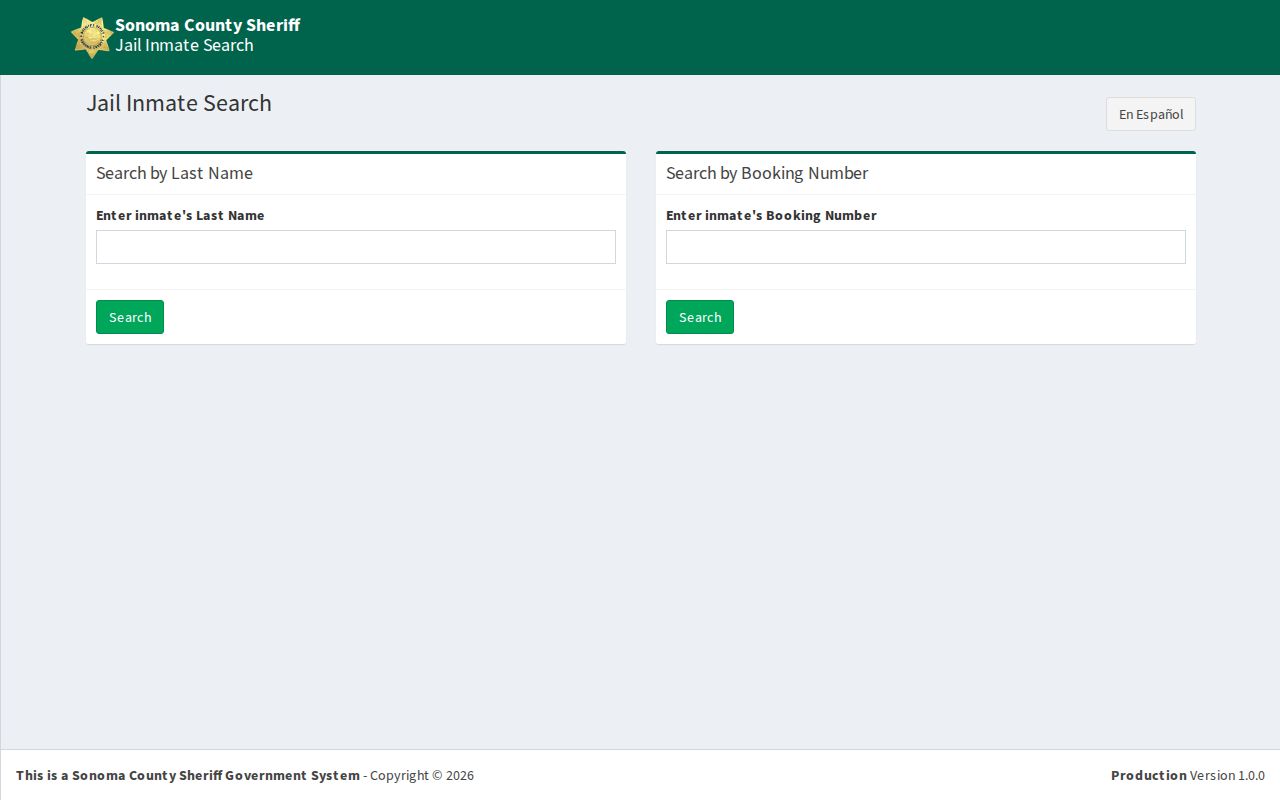
The channel you pick matters. Sonoma County's search shows current inmate details. Its short arrest log sits apart and carries no photos. Tehama County's static roster hides some details behind a name. Tulare says a booking photo's release depends on custody status and the arresting agency's sign-off. None of these local rules make a statewide photo policy. Use the county's own page for its current procedure.
The Sonoma County Sheriff's blank inmate search page loads a form with no results shown.
Note: A county portal can change its search fields or remove a feed, so check the linked agency page before relying on an old instruction.
California Booking Feed Timing
No statewide clock governs booking feeds. Some systems post an entry the moment it is typed in. Others wait and publish a dated report later. Press pages pick only a few events. Holidays and weekends can leave a page looking stale. Trust the feed's own date range and update notice over any same-day assumption. When an entry vanishes, start by checking whether the person is still in custody. Then search the court in the county where the case was filed.
If the short log has already expired, ask the custodian for the date and the record type. Also ask whether the agency holds the photo, or whether another arresting department must approve its release. A photo-free feed proves nothing about the booking photo.
Apps and alerts offer one more local route. They are not a single state service. Fresno, Tulare, and Yuba county files point to sheriff app layers. An app alone never proves a photo exists. VINE and similar custody-notification tools track custody status and alerts, not statewide mugshots. Check each county's current app listing first. Never infer a feature just because the app exists.
California Busted Mugshots Vary
Big urban counties tend to run searchable custody portals, public-information desks, mobile tools, and multiple city-police layers. Even so, their policies can still restrict photos. Rural counties lean on a short static list, a PDF bulletin, a request email, or a records office. Those are tendencies, not population rules. County size alone cannot answer whether a particular photo is public.
Photo gaps have several causes. A system may hide photos by default. The arresting agency may withhold release. A person may have left custody, a court may seal a record, or a safety and investigation exception may apply. So ask more than "is there a picture?" Ask which agency made it, which source holds it now, and which release rule applies.
Start with the California County Directory. Pick the county tied to the arrest. Each local site names its current roster, log, request path, and city-police sources. Those routes narrow a statewide search without copying a face into one central archive.
The California State Association of Counties map lays out the county structure behind local routing.
CDCR Search and Prison Photos
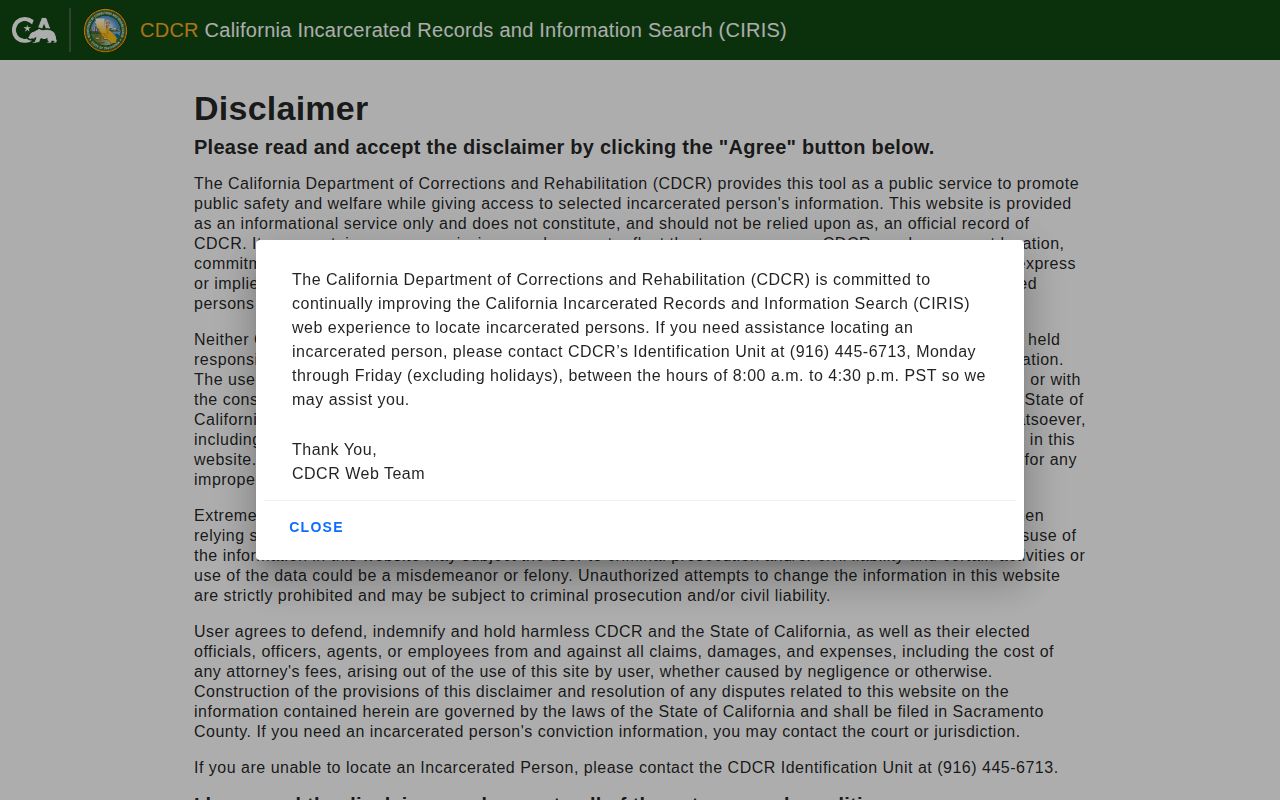
State-prison custody runs through CIRIS. That is the California Incarcerated Records and Information Search, kept by CDCR. It is not a county jail roster. It shows no public offender-photo field either. You can search by last name or CDCR number. Optional fields include first and middle names, an age range, and commitment county. A profile may list name, CDCR number, age, admission date, location, commitment county, parole eligibility, and Board of Parole Hearings dates or outcomes. CIRIS warns that its selected data is not the official record. Errors and omissions are possible. A recent admission or transfer may lag by days. Safety or security limits can also hide a profile. A missing profile does not rule out a state history. The official CIRIS search is the right first check for current state-prison custody.
The CDCR CIRIS landing page hosts the official name and number search.
Want an identification photo? CDCR's media policy sets out a separate request path. Both media and non-media requesters qualify. Safety or active-investigation concerns can still block release. Requests for a person serving or formerly serving state prison go to the Office of Public and Employee Communications. Use opec@cdcr.ca.gov or 916-445-4950, with a full name plus date of birth or CDCR number. More detail sits on the CDCR mugshot and offender-record page.
Court and Federal Custody Searches
California courts run on their own systems. No single public docket search spans every county. The Superior Court where a case was filed is the place to begin. Expect limits. The online portal can restrict remote viewing and may leave documents out entirely. Criminal and juvenile files face the tightest rules. A court lookup tells you whether a case was filed and how it ended. It will not hand you a booking photo.
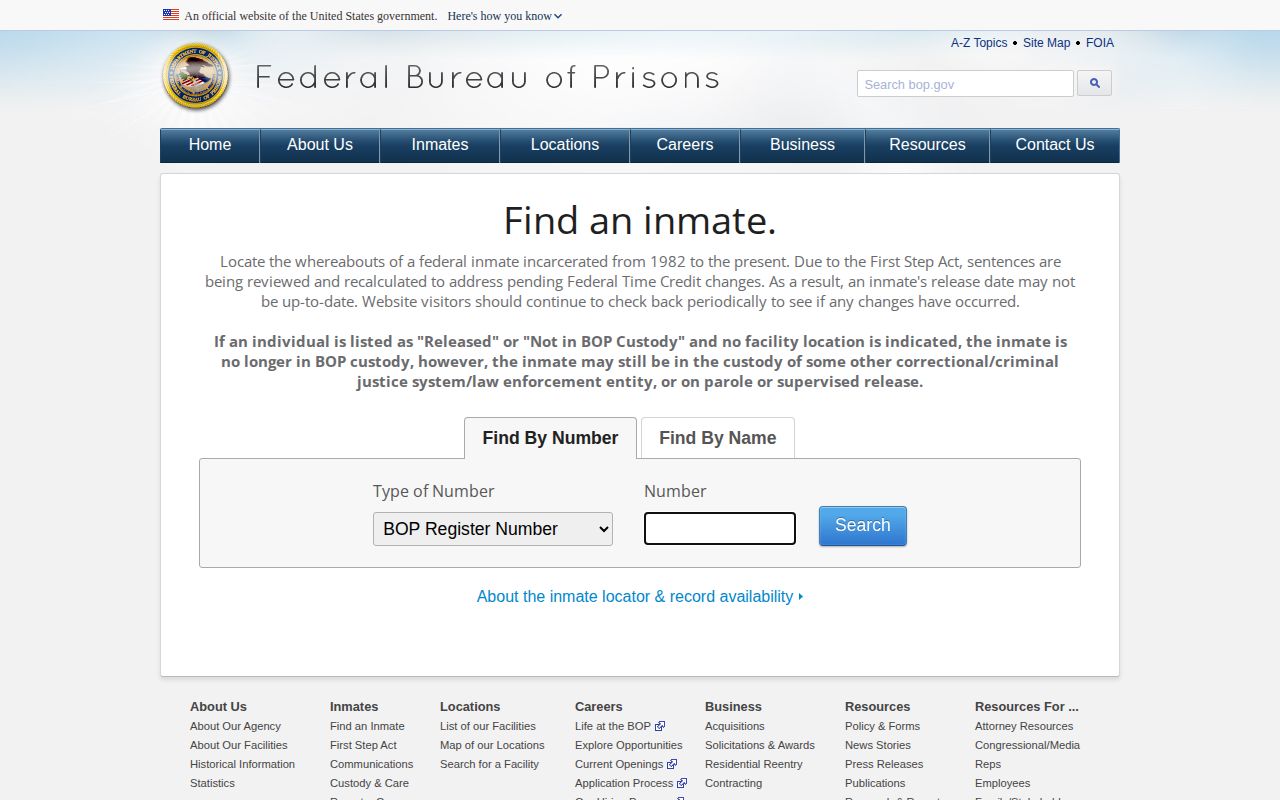
Federal custody sits on a different track from state and county custody. The Bureau of Prisons locator reaches back to 1982 and refreshes daily. You can search by register number. A name search works too, though it wants extra identifying details. What comes back is custody and release information. The tool has no photo field. Immigration detention has its own locator through ICE. It asks for an exact A-number and country of birth. Or use a name plus country of birth, with an optional date of birth. That system is not a full immigration history and posts no public photo gallery.
Each system answers one narrow question. A person might sit in a county jail before transfer. They might land in state prison after sentencing, hold a spot in a federal facility on a separate case, or wait in ICE detention. One result never replaces the county booking record or the court docket.
Use the Federal Bureau of Prisons inmate locator for federal custody records.
Note: A name search can return people with similar names, so compare more than one record field before treating a result as a match.
Busted Mugshots on Secondary Sites
California arrest mirrors gather and republish material pulled from local agencies. Yet none of them holds the record. Treat any hit as a lead. Verify with the sheriff, the police department, or the court. Mirrors carry real risks. An entry can linger after the local roster drops it. A later outcome may never appear. A photo can even attach to the wrong person. An aggregator result proves nothing about current charges or custody.
State and county pages exist at Busted Newspaper, RecentlyBooked, Mugshots.com, Arrests.org, and Mugshots.zone. Their California paths and removal terms shift without notice. Remember what they are not. This is no government roster, no complete statewide file, and no substitute for the agency's own record.
When a mirror shows an entry, match its name and date against the original county record. Then turn to the Superior Court for the disposition. A favorable outcome can back a free correction request under an operator's stated policy. That route stands apart from official record relief and carries no guarantee. Statewide law does bar publishers from charging the depicted person to remove or change a booking photo. One more catch: a page marked "removed" does not scrub copied search snippets. News archives and other publishers can keep their copies too.
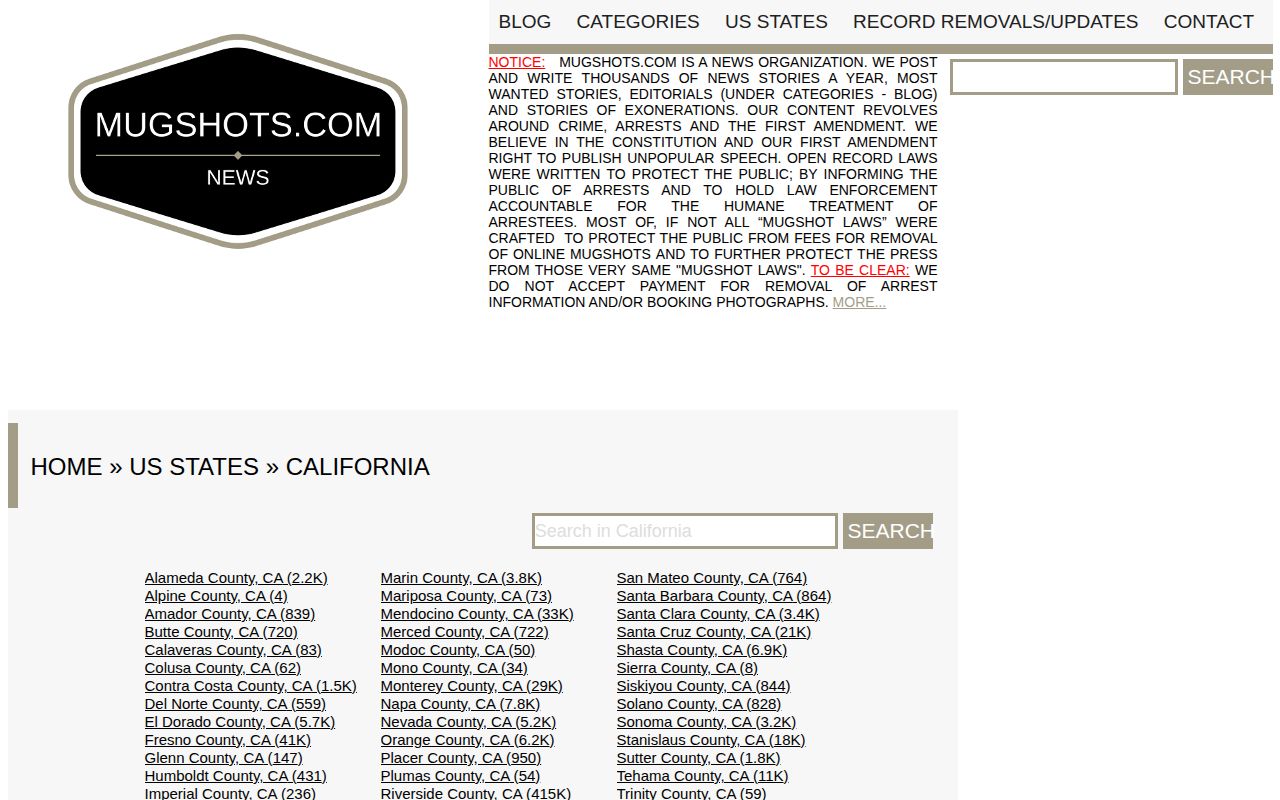
The California navigation view at Mugshots.com sits outside the official system. It pulls from a private site, not a county roster.
California Busted Wanted Notices
A wanted notice is a public-safety plea, not a warrant search. The California DOJ Most Wanted contact page collects tips. It funnels them to the Bureau of Investigation and Intelligence. The statewide Wanted Persons System serves law enforcement only. It is not open to the public. CDCR posts selected parole-related tip information, and the U.S. Marshals Service profiles chosen fugitives by district. Not one of these pages lists every active California warrant.
To check a specific possible warrant, find the court or agency tied to the case and use its official inquiry route. County procedures vary. A statewide wanted page cannot confirm each local bench or arrest warrant. The County Directory offers a safe route through the selected county's court and records channels. Never approach anyone shown on a notice. Call 911 for urgent danger. Send other information to the listed agency or tip line.
The California DOJ wanted contact page offers official tip routes but no public statewide warrant database.
California Booking and Court Terms
These terms mark different points in the record chain. A label on a jail screen often reflects only what the agency entered at intake, not what a judge later found.
- Booking
- The administrative intake after an arrest, including identity checks and the creation of a custody record.
- Arraignment
- An early court hearing where a judge addresses the filed charge and the defendant’s response.
- Disposition
- The court’s recorded outcome, such as dismissal, acquittal, plea, or verdict.
- Sealing
- A legal order or rule that limits public access to a qualifying record while preserving access allowed by law.
- Expungement
- A common term for record relief; California statutes use specific forms of dismissal, sealing, or relief, each with different effects.
Note: A booked person may be released before arraignment, and a court disposition may take much longer than a jail roster entry.